Introducing Orvelt - Protecting Truth in the Internet of Lies
Upholding the internet's promise has never felt more precarious. Despite the technological progress of the past few years, the internet as we know it has in many significant ways regressed. It has come to resemble top-down networking patterns synonymous with the cable companies in the 60s. Ultimately, top-down power structures lead to environments susceptible to mass manipulation of thought. Orvelt aims to reverse that shift by offering a platform for truthful civic engagement, while ensuring that this transition does not inadvertently replace one totalitarian system with another.
To understand the internet's promise, we must venture back in time to learn about communications revolutions. History has shown us that, without deliberate effort, new technologies often end up reflecting undesirable human tendencies, as they are hijacked first by fanaticism and then by greed. This has had many names over the years; Mark Surman in Wired Words calls it the "hardware and paradise loop," where people believe that new communications revolutions will single-handedly trigger massive social change driven purely by their technical properties, at a scale unprecedented in human history. Unsurprisingly, this never quite materializes, and people must ultimately step up to make meaningful change.

From the 1940s through the 1960s, however, cable technology swept across cities, connecting residents in novel ways. Local stations broadcast a wide range of programs tailored to the communities they served. Many saw this evolution of electricity as a force that could liberate the world. With 2-way cable systems like QUBE just on the horizon, visionaries like Michael Shamberg imagined interactive cable technology to be an "extension of self expression."
By the late 1960s, the cable industry had consolidated into an oligopoly under the likes of Viacom and H&B American. This consolidation not only killed diversity but also led to scarcity of bandwidth for local stations. Soon after, the cable revolution rhetoric started to flourish, where individuals compared this scarcity of bandwidth to an attack on democracy. Fortunately, centralization did not last long, giving way to the internet as we know it today. Marshall McLuhan precisely anticipated it when he wrote, "The next medium, whatever it is — it may be the extension of consciousness — will include television as its content, not as its environment".
When the internet was first introduced, with Al Gore hyping up the "information superhighway," it was promised to redeem society and be the bastion of democracy, given its capability to transfer packets in a bidirectional manner, in contrast to the unidirectional cable. Yet it was soon seized by hyperscalers. Subscription has become the new tax. SaaS products are not only baked into our personal budgets but also into the budgets of any non-SaaS institutions, including national defence. With every pro subscription, we have paywalled democracy behind just $20 a month. This is not to present a completely pessimistic view of the internet. Unlike cable, it has in many ways driven genuine democratic change. Truly free software exists, and the greatest of SaaS cannot avoid using them, ultimately contributing both funds and effort back to OSS. Social media, despite its shortcomings, has given individuals a way to hold companies and nation states accountable, and it is easier than ever to reach global audiences. The internet at least promises everyone a voice and an opportunity to be heard. AI is now quietly eroding that promise, slowly but surely suppressing our thoughts and our voices, stripping us of our human dignity; SaaS companies weren't the pinnacle of evil after all.
We are still early in the "AI" arc of history, and we must tread carefully. Large Language Models come with similarly democratic promises as previous communications revolutions: everyone starting their own business, the world’s research at your fingertips, just to name a few. However, AI exhibits a critical structural problem: unlike the internet, which emerged as a largely grassroots-based project, AI models are top-down by design. Here, users are consumers wielding little to no control over the model.
In a way, we’re going back to an earlier time, increasingly siloed from one another; the diversity and interactivity the internet once promised has been replaced by Google's "AI Overview," algorithms feeding us tailored content, and sycophantic models confirming our beliefs. Your thoughts are being suppressed, and the illusion of choice is at its all time high. LLMs are metastasizing on the internet, leeching on your data, infesting your screen time with fabricated content, and quietly narrowing the range of thought deemed worth surfacing.
Trust died first, then extraction became the goal. Over time, the internet was turned from a community into a means to an end. It is easier than ever to manipulate public dialogue in an internet-dependent society. If you have ventured on tech twitter or been to SF, you likely know why. These “copywriting” companies go by many names (look up "organic marketing with AI" if you're curious) but we won’t backlink them. Copywriting is a tool as old as business itself, but at the scale LLMs enable, it becomes indistinguishable from propaganda. And it’s working. People are still adjusting to the reality of the post-LLM world, where every social media post is potentially untrustworthy. That Reddit post you sought out for a quick recommendation? Yes, all the commenters were bots, and we hate to break it to you, but the post itself was also carefully crafted with the help of AI, engineered for your exact need, waiting to be discovered by you. As this data bleeds into LLM training, you become subject to manipulation by these companies without ever knowing it. At least two of them reached unicorn status in under two years, raising over $100 million in funding…
At Orvelt, we believe that such propaganda will lead to the flourishing of totalitarian systems.
Orvelt aims to stand by the legacy of Orwell §, Anti-Totalitarianism and Objective Truth. Orvelt also happens to be an anagram for revolt. Our belief is simple: return people their agency and voice– everything else will follow. As AI accelerates the propaganda war, adapting to this post-LLM world demands protecting the human voice.
Worldcoin/World claim that they have the solution with their $2.5 billion "Tools for Humanity" project. But even setting aside whether the IrisCode database securely stores iris data, and ignoring that Worldcoin is infrastructure-dependent on Tools for Humanity, a VC-funded for-profit, Worldcoin is not collusion-resistant. One can easily buy the hardware-bound World IDs for as little as $30, immediately breaking Sybil protection. Sophisticated actors can pool World IDs together to spread propaganda. Since propaganda is indistinguishable from human opinions, slashing and other protection mechanisms commonly enforced in crypto are impossible to implement due to inadequate detection criteria. Any system using Sybil-resistance mechanisms will require additional information to prevent misuse, inevitably proliferating the surveillance state. Uniqueness provenance, as currently conceived, protects activities from bots and malicious actors — but only by treating every user as a suspect.
Perhaps you don't need to prove your uniqueness as a user, if you could prove your uniqueness with respect to the activity you are trying to pursue.
At Orvelt, we are experimenting with common-sense techniques to verify opinions securely and seamlessly. For example, if you want to express your opinion about a store you visited, it is only fair that you provide evidence to support your claims.
- Weaker evidence would be a picture of the store,
- Stronger evidence would be a picture of a recent receipt from the store,
- Weaker evidence than that would be having a previously verified receipt from a store nearby.
If you have a say about how Mayor Mamdani filled 66,000 holes†, it is only fair that you share a picture of a street in New York. Stronger evidence would be a city electric bill proving your residence.
We will accept all levels of evidence, or no evidence at all ~ choice is yours to make. We will for no reason reject your opinion‡. Your opinions rise to the top on an objective basis of how truthful your claim is. We believe that providing evidence is preferable over having your opinions cancelled by AI bots or your information being forever tracked and profiled by the surveillance state.
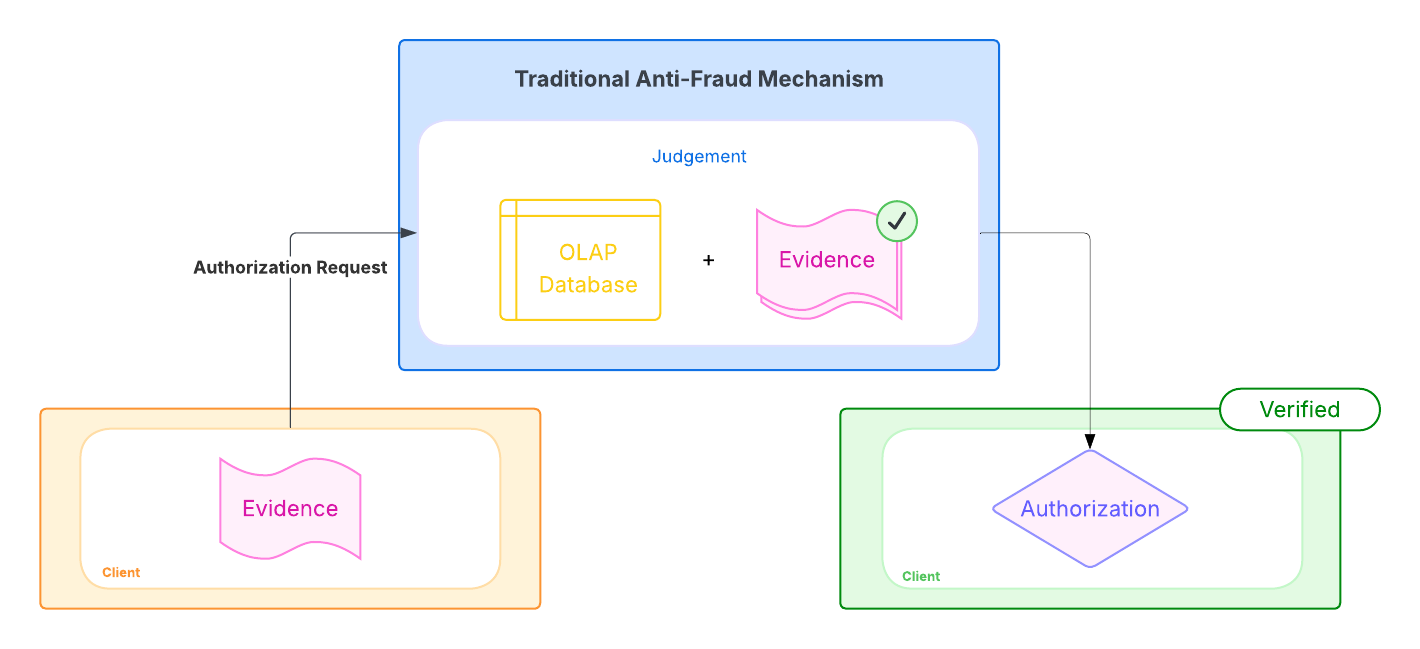
This isn't some novel technology; it is in many ways similar to the process that banks have used for verification of transactions and detecting fraud. But banks also share your data with credit bureaus and advertisement companies, making you a predictable number on a spreadsheet.
Orvelt takes the opposite approach: we take your data privacy extremely seriously. Every evidence verification attempt has its own life and at the end only proofs remain accessible to us.
- Your evidence originates from your device, encrypted with a time-bound key that grants us one-time access.
- Features are extracted†† from the decrypted evidence using Vision Transformers (ViT) and/or Sparse Autoencoders trained on Vision Transformers (SAEViTs). Upon key expiry, the evidence, including its metadata, becomes permanently inaccessible to us.
- We generate a broad cryptographic proof by encoding the feature space. Currently, we automatically obtain full permission to validate against this feature space. In the near future, we plan to introduce granular permissions for people who want full transparency.
- Facts are then validated against feature space proof(s) and a verified badge is presented to the opinion. A full public proof will also be included once we have established a sound verification mechanism and ensured that it is scalable.
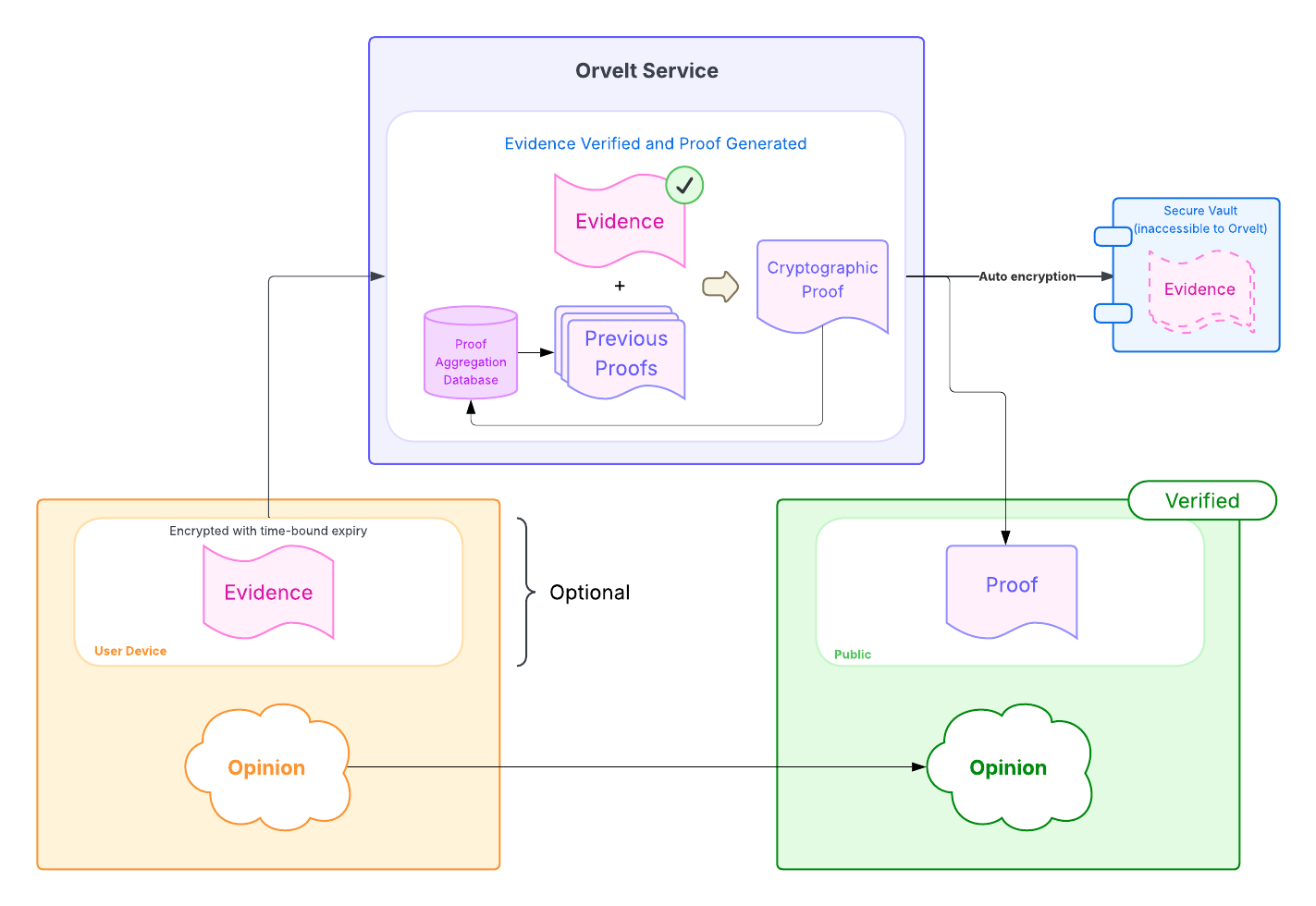
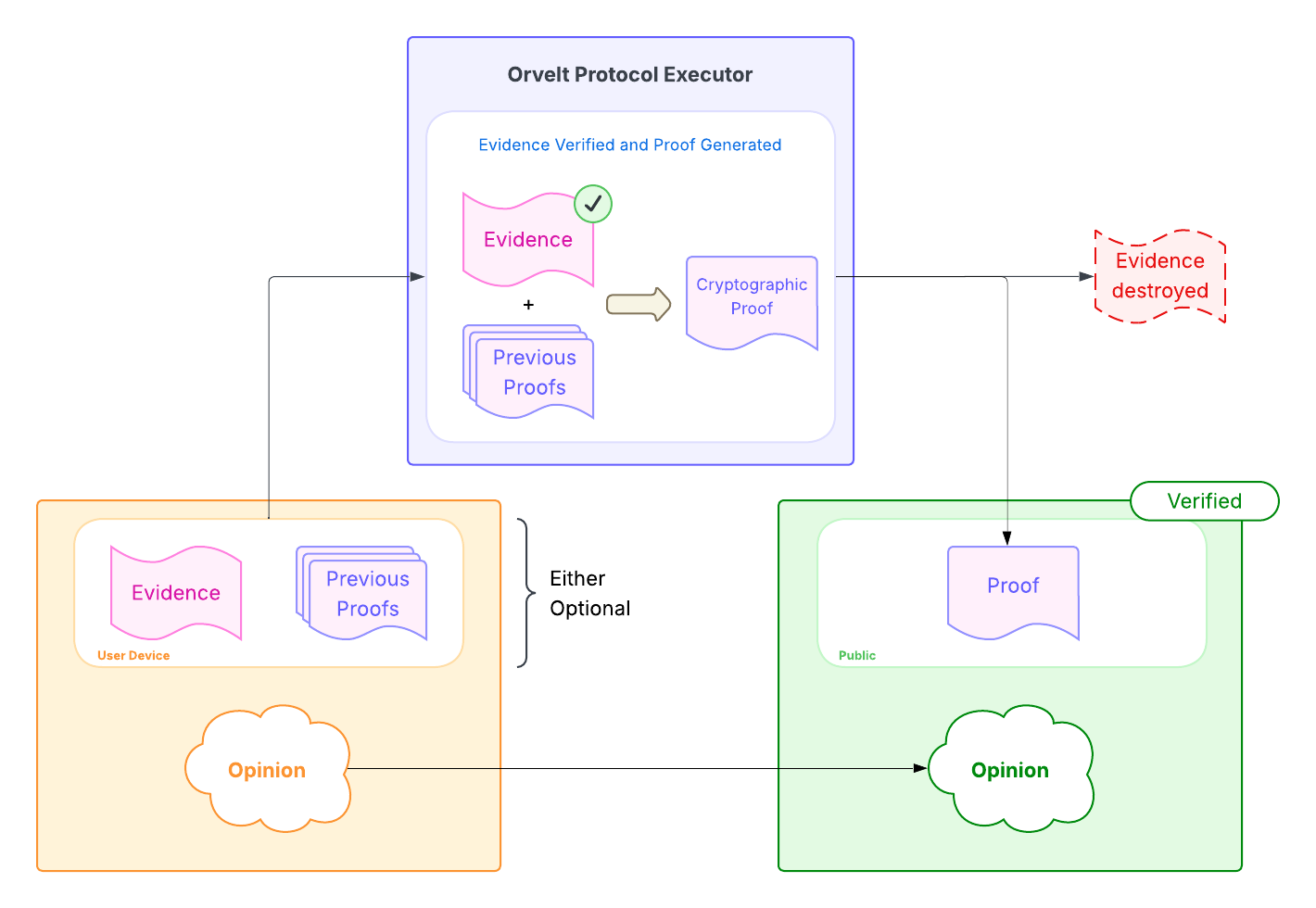
Current architecture requires Orvelt to act as a trusted party for your evidence before it expires. We recognize this as a gap in zero trust. We will bridge this by deploying in verifiably private, trusted execution environments (TEEs), and will publish full technical details in an upcoming whitepaper.
There is a long way to go, both in terms of what is outlined here and beyond. We also want the protocol to be accessible to communities worldwide, extrapolate verification techniques on existing laws, and reduce hardware constraints to the greatest extent.
Stakeholders
People: You can now exercise your freedom of speech without being drowned out by AI bots. On Orvelt, opinions earn verification badges based on evidence, making it nearly impossible for AI bots to gain traction. Because your opinions are grounded in verified evidence, they are afforded the strongest protections of speech under legal systems worldwide. And because we ensure your opinions are represented in LLM outputs, anyone using AI tools will be informed of your perspective.
Orvelt puts power back in the hands of individuals. Our upcoming private opinions feature will keep conversations between you and your community fully encrypted, meaning surveillance systems can’t track and profile you and AI loses its ability to distill information about you. Models will inevitably learn from Orvelt's public opinions, but meaningful analysis becomes impossible when metadata and private opinions are decentralized among all community stakeholders. Your words carry weight: sharing your honest opinions, whether publicly or through our future private opinion feature, can now directly support your community.
Orvelt is currently processing NYC establishments, however you can go ahead and add your opinion for any place worldwide in less than a minute.
Businesses: You can now access truthful opinions from your customer base and analyse them with mathematical precision. Our research shows that more public opinions disproportionately benefit small- to medium-scale businesses over larger well-established corporations.
We believe that the 1-5 star rating system is fundamentally flawed and we plan to overhaul it with a more dialogue stimulating holistic system that highlights your best qualities and informs you of your worst. We expect to offer most Orvelt services free of charge.
Stay tuned for more information. Join our business newsletter to start building your data moat.
Open Source: Orvelt actively uses open-source technologies and contributes back to them. We plan to open-source most of the technology behind Orvelt under permissive licenses (Apache 2.0 or MIT).
Contributor/Funding: Orvelt aims to carefully plan funding in order to limit external interests.
If you would like to contribute to the Orvelt project fiscally, please use this link or contact us at [email protected] . If you would like to contribute anonymously using crypto we will send you our wallet IDs on demand.
If you'd like to volunteer your time instead, feel free to reach out using our form.
There are countless ways that LLMs have and will adversely affect our lives and Orvelt focuses on a small subset of them, one that we believe could have tractable impact. Our goal is not to oppose technological progress, but to address the misinformation propaganda that Large Language Models enable and any causal problems they engender. More Nvidia GPUs will not lead to widespread entrepreneurship, universal basic income, or a freer world; it will only accelerate our path toward oligarchy. Breaking the "hardware and paradise loop" takes consistent effort, and with Orvelt we are here to put in our best.
May truth prevail
__
§ Some might argue that we are heading towards Huxley's addiction-ridden world; however, we believe our world is likely the worst of both possibilities, a "Huxwell" world. We are primarily targeting the Orwellian elements, hence the namesake.
† Orvelt at this moment does not verify opinions regarding political statements or figures, however we might choose to do so in the future.
‡ We might still remove your opinion if it does not comply with the law.
†† Currently the feature space extraction might require additional manual verification.
Ø By design, we, and by extension any law enforcement, do not have access to any evidence linked to you; however, if a situation arises where you must present evidence in a court of law to defend yourself, only you could request authorization of decryption by presenting the proof and a key.
It is important to highlight that Orvelt does NOT issue cryptocurrency in form of tokens or otherwise. We DO NOT endorse any current or future tokens.